Showing posts with label Stashbusting 2014. Show all posts

Saturday, 8 November 2014

Almost Frocktober: Burda Style 05-2013-124 Petticoat and Frock versions. Sewing with silk-hemp and sheer fabric.

DSC04113

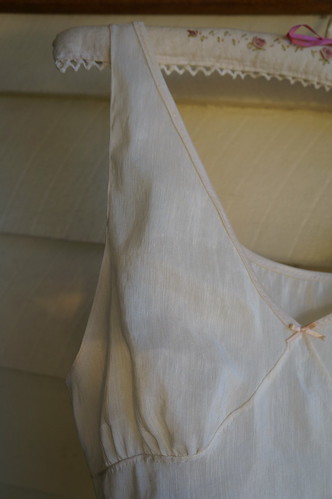
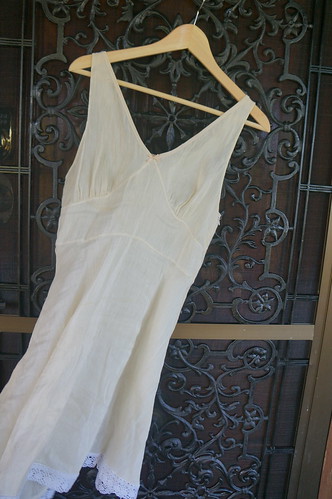
When I inadvertently sewed a see through Tiramisu, I developed a sudden need for a petticoat with a deep v neckline. Naturally, thinking of such a requirement, my mind instantly turned to Burda, who seem to specialize in chest exposing garments.
Fortunately for me, there were some magazines with possible frocks with sticky labels on them lying about on my sewing table, so it didn't take me long to find a candidate, Burda Style 05-2013-124.

 Technical drawing from http://www.burdafashion.com
The only thing was, that I had no idea what fabric to use for a petticoat under a knit dress that would not cling, and would not be too hot to wear for a Spring to Summer garment. I was leaning towards silk charmeuse, this working so well under my merino knits for winter, but really, this is rather a warm fabric for our climate.
Delving deep into the what-was-I-thinking layers of the stash, I came up with some slippery, semi-translucent,slubby, bouncy fabric that I vaguely remembered was silk/hemp. I posted about this 2011 purchase here. (In the interest of unusual fabric reporting, the hemp/cotton sheets are wearing nicely and are now beautifully soft, and the hemp/cotton knit top is now just like a rag but I am still wearing it around the house because it is so comfortable- this made me more willing to try this unused fabric, which is really quite unusual - my husband said "plasticy")
DSC04120

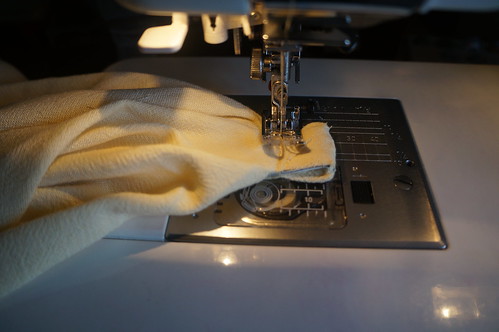
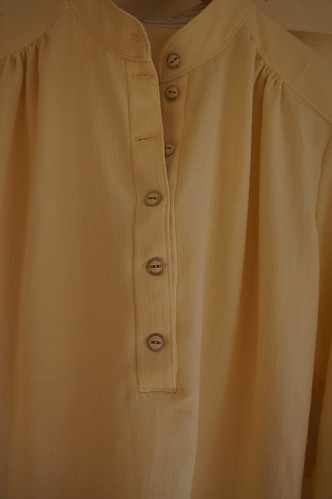
I had some fun making this. I cut out a single layer (and used the Tiramisu skirt, without the center seam - its a similar shape but the skirt is more full). I used several different seam and edge finishes.
At the neckline, I used fold over elastic, slightly stretched. This worked really well, or would have worked really well, had I noticed that I had sewn one of the front bodice pieces on backwards before I applied the elastic.
I am now very practiced at unpicking 3 step zig zag stitch at 1.0mm length from fold over elastic. Sigh
For the underbust seam ( I gathered the bust instead of darts, as I'd enlarged to a D and didn't want to redraw the darts) I folded the gathered seam allowance over the waistband allowance by hand (the gathers were too fiddly by machine) and whipstitched.
For the waistband, side seams and shoulder seams, I used french seams.
For the armscyes (these are trimmed to make the petticoat sit fully underneath the outer garment), I used a fine bias finish - applying bias binding to the right side, turning the bias over the trimmed seam allowance and edgestitching at 1/8 inch, then turning the bias to the wrong side and topstitching. This gave a very neat, thin edge on the silk hemp.
The silk hemp ravels very easily. As it felt so plasticy, I did a burn test, where the fabric burnt like paper, and left long strands of ?hemp after I blew out the flame. This is definitely all natural fibres!

Having finished the petticoat, all the sheer fabrics in my stash suddenly looked very appealing as a frock.
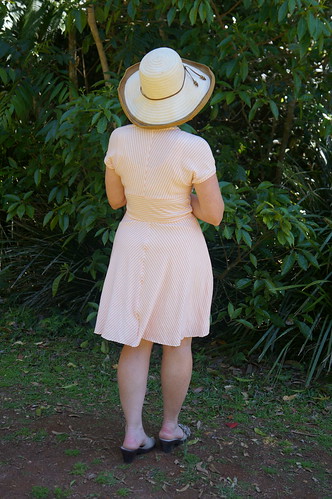
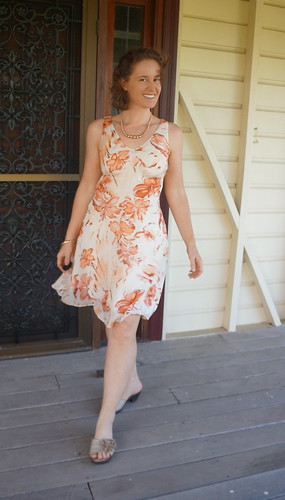
Somehow, I cut out another version of 124 from a mere 1.3m of silk chiffon print that I may have bought to make a scarf.
The chiffon was pre treated in a gelatine bath to improve its handling qualities. I cut out using a rotary cutter, and continued using the size 60 universal needle I had used for the sheer silk hemp garment. This time I used the fine bias edge finish on the (raised 5 cm) neckline as well as the armscyes, but the other seams are mostly finished in the same manner as in the petticoat version.
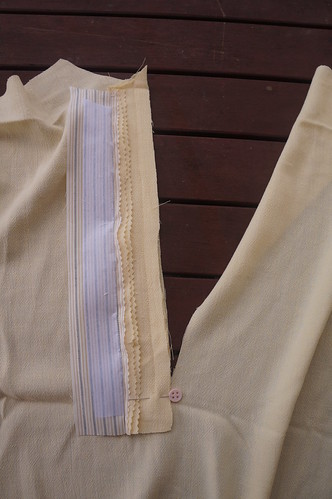
For both versions, the fabric under the invisible zip is reinforced - in the petticoat with a woven nylon ribbon, and in the chiffon frock with a strip of silk organza selvage.

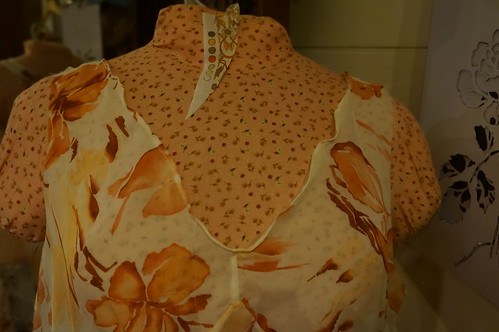
 The silk chiffon dress was a challenge for me. I tried finishing the neckline with the same technique as the armscyes in the petticoat.
Unfortunately I neglected to first stay stitch the neckline, and the neckline rippled in an unsightly manner. (The armscyes in the silk chiffon, finished in the same manner, behaved perfectly)
DSC04065


I tried to fix this with clear elastic, but this attempt failed.
Eventually, I took 2 small pleats from the neckline on either side of centre front , handsewing these, and was content with the fit and finish. However, it is not my best work. I anticipate becoming a better seamstress with my next silk chiffon frock!

DSC04104

I was pleased with my other seam finishes on the sheer fabric. Having just practiced on the silk hemp, I was able to make french seams throughout, including the curved underbust seam, which contains gathers. I pat myself on the back a bit for this.

DSC04122
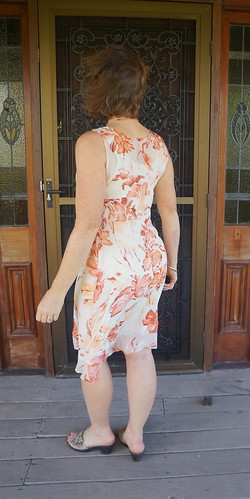
In the end, I have a pretty, floaty dress in time for seasonal socialising, which does not photograph to advantage on a windy day.


DSC04110


Tuesday, 21 October 2014

Frocktober: Tiramisu

DSC04060

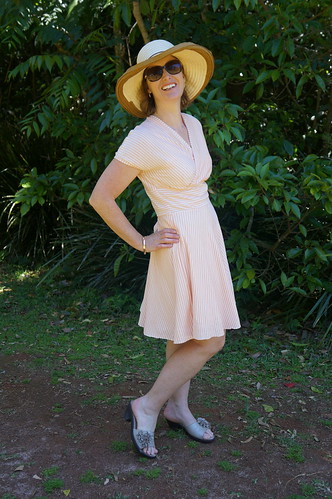
It is highly unlikely that a dubious not-what-I-expected internet purchase fabric and a pattern-bought-for-other-than-aesthetic-appeal would, in combination, turn into my new favourite at-home dress, but somehow, 2 wrongs have made a right. How did this happen? Sewing serendipity is not a frequent occurrence under these circumstances.

Tiramisu

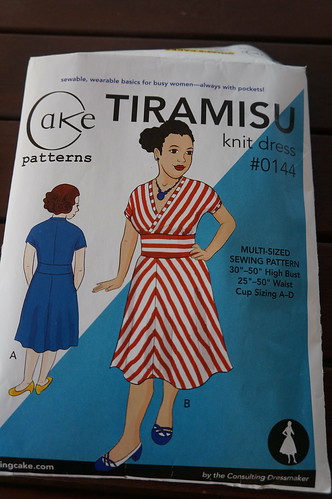
I was making a not wearable muslin, out of a sense of duty and thriftiness. The pattern, you have already read in the title, was Tiramisu from Cake Patterns. I bought this pattern last Spring in the pre release sale, thinking that although I had several wrap and mock wrap knit dress patterns, and I loathe cut on sleeves, it would be a Good Thing to buy a pattern from a relatively local blogger- newly-turned-sewing-businesswoman in the initial throes of her start up. My vague thought that I would make up this dress straight away and get it over with was instantly killed by the teenage fashion panel, who thought the pattern illustration looked dumpy. Dumpy is not a good word. I realise that there is a unwritten rule in blogging that when a micro pattern company is deliberately using "realistic" illustrations you are not supposed to criticize them, but there you are, Dumpy. We must be indoctrinated by the fashion industry to expect 6 foot underweight imaginary models for pattern illustrations, very sad.
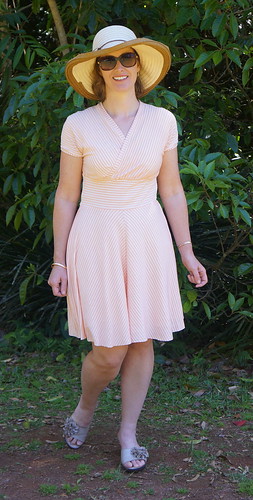
This is also why I gave in to the commands took my teenage fashionista photographer's advice to pose in a "look at me" manner as above. I am astounded by the apparent skinniness of the first shot. How deceptive! I shall have to stand side on and leaning backwards for the rest of my life.
Unfortunately  I do not think this is possible.

DSC04054

I knew that there were many, many completely non-dumpy versions of this dress on the internet, but one's personal teenage fashion panel is fairly influential, and the pattern had a dumpy aura in our house that was hard to shake off.
I have a long term goal to use all my patterns and not have lurking fabric stash dwellers. To try out this dumpy dress, that could possibly be a dress-about-the-house if my daughters were not at home to despise it, I used a striped rayon knit that is very thin. This was not a fabric I would have purchased in a shop, but on the internet it was called medium weight and suitable for t shirts. Some people must like to wear see- through t shirts. I really thought I would be using up two dubious possessions at once, and clearing out my sewing materials oversupply.
I sort of fancied the illustration of the stripey version of the dress, although personally I usually think that cutting out a knit on the bias is a waste of fabric. Knits already drape and stretch rather a lot. Increasing the drape and stretch on my thin and not-very-stable knit by following the bias cut out was possibly a bad decision, but I did it anyway.
However, I did not throw caution completely to the wind. I stabilised a lot - more than suggested by the pattern instructions.

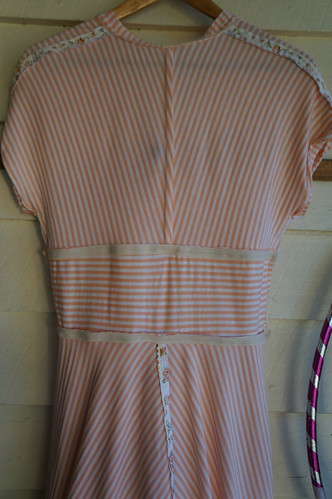
The horizontal seams are stablised with lingerie elastic, no stretch. The bias vertical seams are stabilized with woven selvage ( I used woven selvage where the pattern instructed fusible interfacing as well). I added clear elastic (slight stretch) when topstitching the neck binding.
 I didn't use the pockets. Pockets in a knit have a tendency to stretch whenever you put anything in them, which I find unappealing.
DSC03942

I quite liked this pattern as I cut it out - several cup sizes, including A as different from B, and up to D, check. Draw your own waist measurement, check. However, having only one size for high bust 30 (inches) to 34 (inches)? Uncheck. I am the smallest size, and so are my daughters? Come on, I am 43! I am not skinny! My daughters are not the same size as me, and yet are fully grown and quite normal sized young women, and this dress does not come in their sizes, as the smallest size was fine on me, and like a sack on them - that would be the 10 cm of extra ease they don't need at the bust! Taking in this much at the side seams as suggested is a lot of distortion, and when I pinned it, still looked awful on them. In my opinion, this pattern starts at a size 34 high bust, which would be about a size 38 in Burda, a size 12 in big 4 patterns (or 10 really, as Big 4 have a lot of ease). This is limiting.

I did not like this pattern as I sewed it up. 1/2 inch as a seam allowance simply meant that I sewed all seams at 5/8inch, 1.5cm, as this is what I am used to sewing, and where the guidelines are on my machine. Using a non standard seam allowance just for the sake of it is annoying.Knits don't need this much seam allowance, but what is wrong with using other standard measurements such as 1cm,( 3/8 inch) or even 1/4 inch. Grumble, grumble.
It was with the full expectation of being about to throw this in the the bin that I tried on the dress after wasting and afternoon sewing it indulging in some experimental sewing.
It looked much better than I expected.
Only see through.
I made a petticoat (more about this later).
DSC03940
I am eating humble pie.
It is a terrific dress pattern.
I even like the cut on sleeves, how strange.

DSC04057

I will consider buying more of these patterns - but not for my daughters.

 Stashbusting statistics 2.3 m or so of overly thin rayon knit from an unmentionable internet source, 2013 + 2.3 m or so of thicker rayon knit from the remnant warehouse 2013.


Saturday, 11 October 2014

Threshold shorts

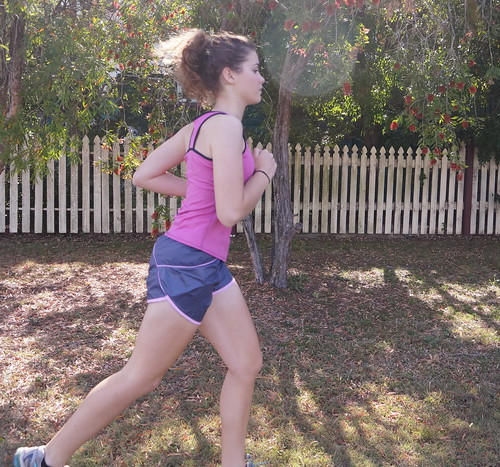
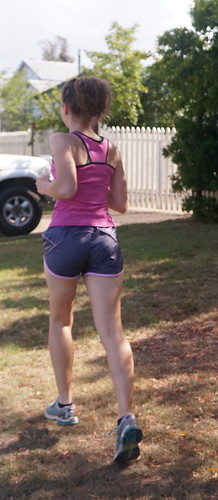
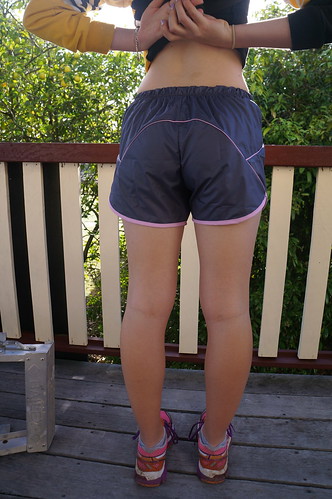
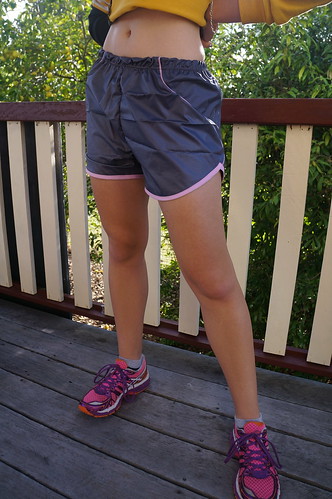
Melissa was very apologetic about sending all her pattern testers a running shorts pattern to try out in September, but it worked out just fine for my family. Sometimes it is a benefit to be in the southern hemisphere. This pattern was released a few weeks ago, Threshold Shorts.

DSC03929
 
I wanted to write about these shorts previously, but although I've made several pairs already, they have hardly been out of the laundry for photos.

DSC03933
 
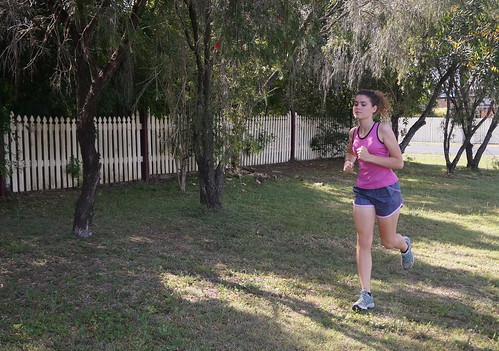
Here they are running past.
DSC03935
See, I almost caught them (That's an XYT top, also from Fehr Trade)

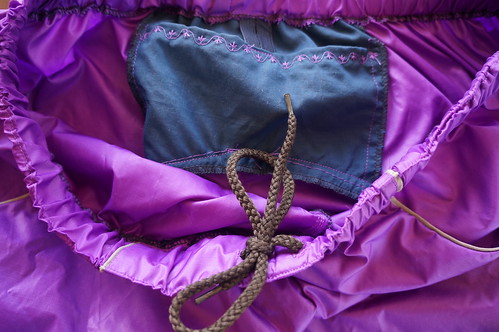
This, you might notice, is the first pair belonging to Daughter the second, who trains most days, and competes in middle and long distance running and triathalon at regional and state level (school athletics). She likes these shorts, and compares them favourably to her many pairs of RTW running shorts including those from high end brands. (She might be a bit spoilt with athletic gear). Her only request for successive pairs is that I include a drawstring at the waist in addition to the the elastic.
DSC03788
This is easy to add - you just need to make buttonholes in the cut on waistband before sewing it down as a casing with a gap, (you don't use Melissa's elastic application instructions) and you thread through both the elastic and drawstrings through the gap in the casing, then sew the elastic to fit).
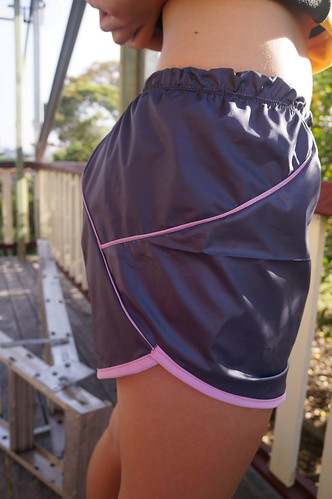
Fabric: woven nylon supplex (2oz) from The Rainshed (2009 or so), piping and binding from prepackaged polycotton bias binding.
Most of the other versions I've seen on blogs are in stretch fabrics, so I am pleased to have tried them in the woven so I can let you know that they work very well in this fabric too.
These are a lot of fun to sew, with beautiful curving seams that just cry out for piping. I could not resist this even in the test pair.

DSC03784 


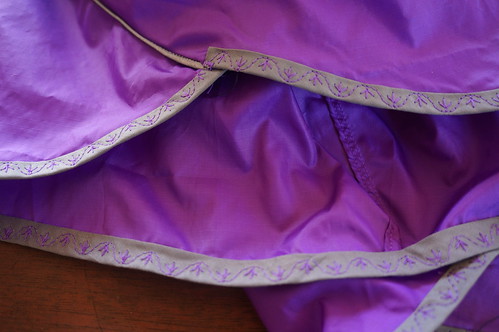
I also really like the binding and the shaping of the bottom of the leg.
DSC03789
I embellished this with some machine embroidery for sewing amusement.

Personally I find it very exciting to have a utilitarian garment, tested in the activity for which it is intended by multiple end users, that is actually interesting to sew.

DSC03783

I am very impressed by Melissa's dedication to making a pattern work for everybody. She sends out an already really good pattern, then graciously listens and responds to all the whinging about very minor issues and personal sewing difficulties, then changes the pattern to accommodate lots of tweaks and expand the already comprehensive instructions-for-the spatially challenged (my words, not hers), and also to include a variety of fitting tips. If it were my precious pattern I'd spent months making, I know I would be feeling rather protective about it.

I love new patterns, and have quite the addiction to them, so I quite enjoy testing patterns, but I am quite ruthless about them. I have tested things for another new pattern company, and not blogged about it, as it is not my intention to provide pseudo advertising in addition to making up a "free" pattern with my own fabric and in my precious sewing time (see, I am a nasty cynical person).  I didn't blog about the other pattern company because a) I had nothing particularly nice to say about the very simple pattern and b) I thought there were major faults in the pattern, and noted that there were no changes at all to the finished product - making me think that the pattern "testing"  of this other new business was a lie. I won't be wasting my time or stash testing for that particular company again.

DSC03785

 Melissa has an unusual ability to listen to her testers, and it seems to me, that she is dedicated to providing patterns that not only look like up to date athletic RTW, but are ideal technical garments for vigorous activity. I have multiple garments in 3 of the patterns I have from her line, and will continue to use them for our exercise gear. Had I bought them, they would be some of my most value-for-money patterns (I have A Lot of patterns) due to the number of times they have been used already. Please note, this is unsolicited admiration. Melissa provides a pattern pdf to those who test, but no conditions are attached to receipt of this pattern other than a request to test it and to provide feedback.

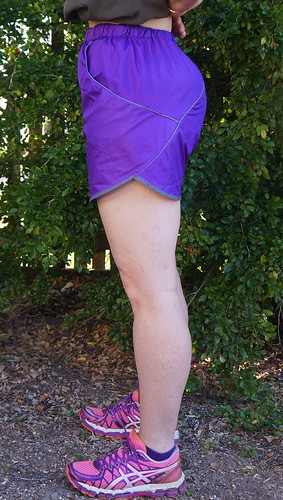
Here is my second pair for me, in which I tried out all the pockets. For me, the pockets need to be deepened - instructions for this are in the final pattern.
DSC03794

 Unfortunately, this pair is not yet up to vigorous activity.
I lengthened these a tad (instructions for lengthening in the pattern), for middle aged legs, but made no fitting adjustments as yet (I did also increase the waist height, prefering a wider elastic here). As is usual with my trouser-resistant-figure, there are some fitting changes needed to make these practical for running - notably a front thigh expansion adjustment, which Melissa has now included in her pattern. Surprisingly, I do not need to change the back crotch depth, which I usually do for my generosity of backside, but this may be due to the large amount of ease at the waist - controlled by elastic and drawstring.

These however, after additional lengthening for my personal preference for leg coverage, have proved very useful to wear over my swimmers during a sedate walk to the local swimming pool - and also as board shorts at the beach, so quite useful after all.

Stashbusting statistics about 2 m of remanants, nylon supplex The Rainshed, 2009 (3pr shorts)

Saturday, 14 June 2014

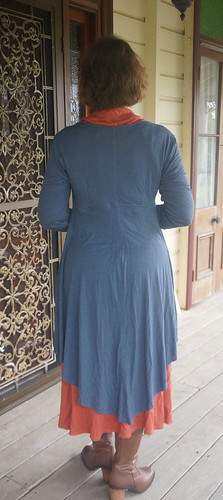
Work wardrobe miss, Burda Style 03-2012-122 Long cardigan

I  was making a long line cardigan to throw on over my new work clothes for the walk there and back, which can be a bit chilly (for wimpy persons who are used to hot weather). I was very taken with the lovely knit jackets Sew Jean Margaret wore during Me Made May, hence the plan, but alas, my knit cardigan does not look very good with my work clothes. My cardigan is unfortunately reminiscent of a bathrobe, when worn over trousers and a business shirt, so initially I was fairly unpleased with this project.

DSC03477

 I do like it though, over a knit dress for wearing on the weekend, so all is well!

 The pattern is from Burda Style, 03-2012-122, and I've made it before (the alterations are described in the earlier post), in a very fine gauze merino knit - it was terrific for travelling, rolling up to next-to-nothing, but the gauze did not hold up very well to regular wear and ended up being turned into a wildly successful scarf.


technical drawing from http://www.burdafashion.com
This time I used a fine, but not gauze, merino knit, again from The Fabric Store and I think this slightly more robust fabric will hold up a bit better. However, it seems significantly more stretchy than the previous version, and has ended up oversized, despite some drastic reducing action at the side seams.
What I like about it particularly, is that although not magically slimming from behind, it is far more shapely than most long-line knit cardigans in this view, due to the darts and waistline shaping.

DSC03480


As in my last version, I have reinforced several seams (waistline, neckline) with clear elastic, and the shoulder seams are reinforced with woven selvage.
The tie bands are rolled sections of the knit.
It is just as comfortable as a bathrobe.

stashbusting statistics, about 1.5m of merino knit, 2013


Thursday, 12 June 2014

Sorbetto

Thank you for all the kind comments re everyday sewing. It is reassuring to read that other people like to see real life clothes!
My latest project was very quick, easy and pleasing.

DSC03440

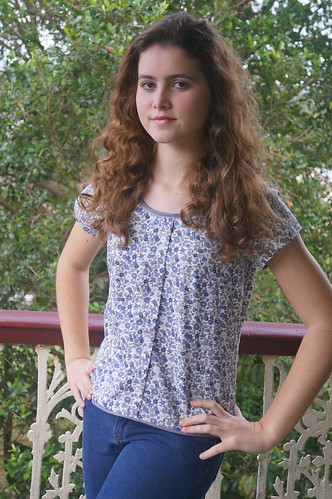
I had some scraps left over from my latest work blouse, and thought I'd try the free Sorbetto pattern from Colette patterns. I am possibly the last sewing blogger to try this, but was a bit put off by comments from some curvaceous persons who found this unflattering, so had it lying around in the sewing room waiting for the right remnants.
Well, it is just perfect on a slim teenager, even if she has an hourglass figure.
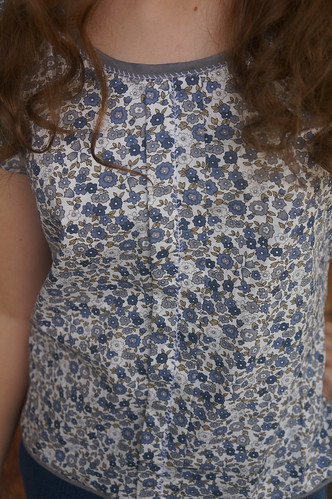
Size 0, with the sleeves from Sew Incidentally, not even scaled down to a 0 (the sleeve is about a 6), and with no adjusting of allegedly incompatible seam allowances. I told you it was quick and easy! (I think it took about an hour to cut out and sew)

I was actually inspired to make this by  SusanKPs pretty blouse in her latest 6pac. I didn't use her good idea of  mid section gathering, but used the pleat in the pattern.
As I had to cut the front out in two sections, with a joining seam, I used a machine embroidery feather stitch in a hopefully disguising manner along this seam, and also used this stitch to embellish the neckline binding.

DSC03456

The hem is bound as well, as the top is actually for my older daughter, who is not only taller than daughter the second (there wasn't a lot of fabric left), but lives mostly in Brisbane, a few hundred km away, so can afford to introduce the same fabrics as her mother wears into her wardrobe, as no one will ever see her mother.
Now I am under strict instructions to make a second one for this particular model, or maybe 3 or 4?
Stashbusting statistics - about a metre of remnant cotton. The benefits of sewing size 0!

Tuesday, 10 June 2014

Wardrobe balance + BWOF 01-2008-107 shirt, self drafted trousers

Me-made-May seems to have a subtitle in the reflection posts. Is what you sew, what you wear? I wear what I sew, but unfortunately, at times, this is boring in the sewing phase. It is a bad thing when you find your own blog and your favourite hobby rather dull. I hope this will pass! I am keeping it real. Sewing is not just pretty things for self (or daughter) adornment. Wardrobe building is not very exciting, but it needs to be done if you are anti fast-fashion or don't fit RTW. How to do it well, without excess expense, and in a minimal number of garments is endlessly interesting in theory. See this thread and its precursors.
I like a blog with shiny new patterns and endless party outfits as much as the next person, but my real life includes lots of clothes for work, exercise outfits for middle aged persons, and t shirts for the conservative 11 year old male. If sewing was just a hobby for me, I could be a dilettante, but fortunately for my budget, sewing has practical aspects around here.
I find it interesting, in the Me-Made-May round ups, that several people have said they have too many clothes, but still find it hard to find things to wear every day. I think Mikhaela sums it up very nicely here. Too many lovely clothes that aren't worn much, and not enough every day clothes that meet practical needs.
Of course, this could mean that we don't dress up enough in everyday life, despite having more options that the non sewing majority.
Clio says that nearly everyone wears a dress to the sewing meet ups,and wonders why. I guess that depends on your climate and lifestyle. I wear dresses for most of the year - but not to work.
Rachel of House of Pinhero says 65% of the clothes she's sewn are dresses.
I think I'll write down what type of clothing I wear the most, and see if I can balance my sewing with my wardrobe needs. This sounds a little like Carolyn's project where she sketched everything she wore for a year (such an organised lady, I'm in awe of her sewing and artistic skills), but I will not be sketching.
Here are more everyday clothes, that I needed a sew-a- long and self persuasion techniques to sew instead of something more interesting.

DSC03437

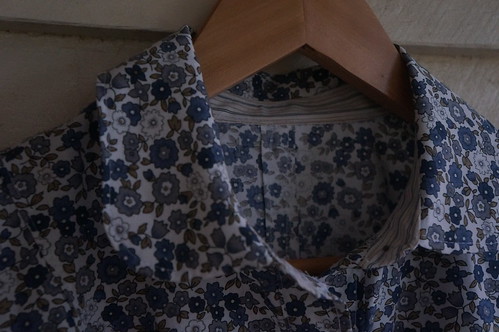
Blouse 01-2008-107 again, in a subdued Mumsy floral - possibly the floral is pushing the professional boundaries at work, floral has so little gravitas, but it is inoffensive. Hopefully the business-like shape of the shirt balances the prettiness.
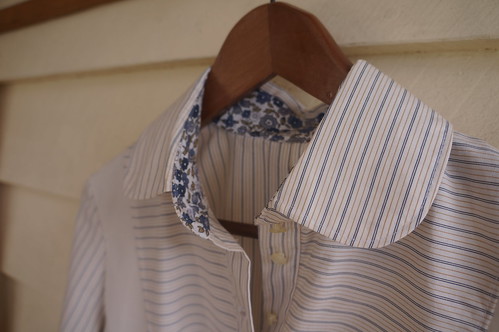
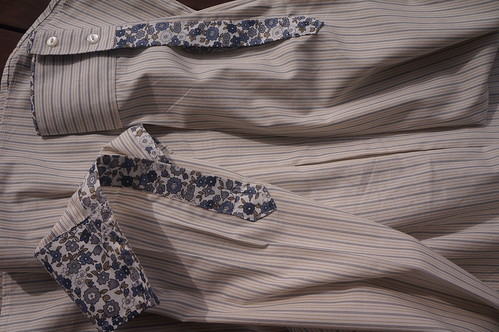
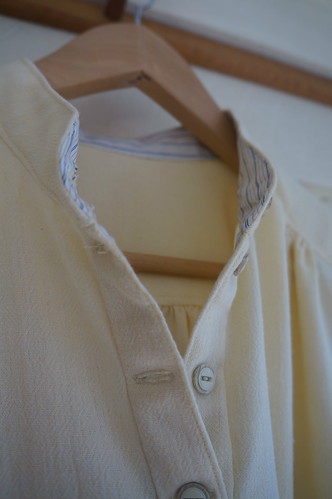
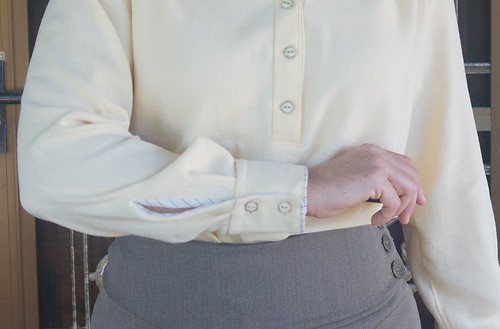
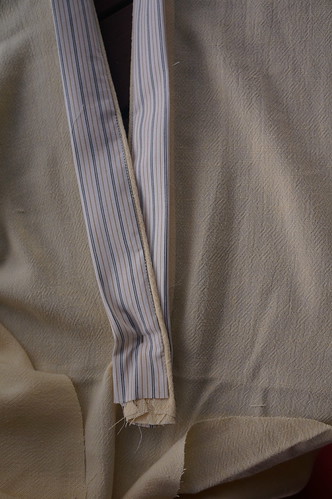
There is some more business-like stripe on the inside of the (narrowed) collar stand and in the cuffs, but there wasn't enough for the plackets.
DSC03438
 Worn with Self drafted Useful trousers for work
Why are work clothes so boring to sew?
I'll like wearing these much better than I would like shopping for  or wearing ill fitting ugly work clothes, I just have to convince myself that this is what I want to make. Really.

Stashbusting statistics: About 1.5m of mid weight cotton woven, provenance forgotten, but a few years old

Sunday, 8 June 2014

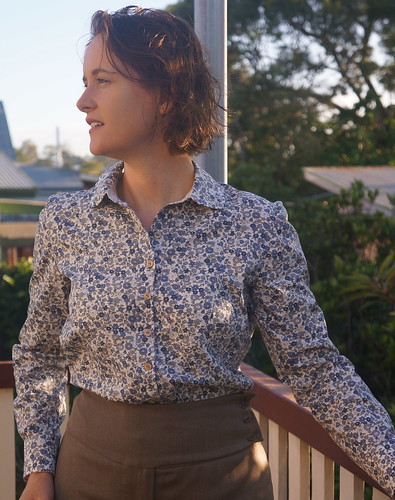
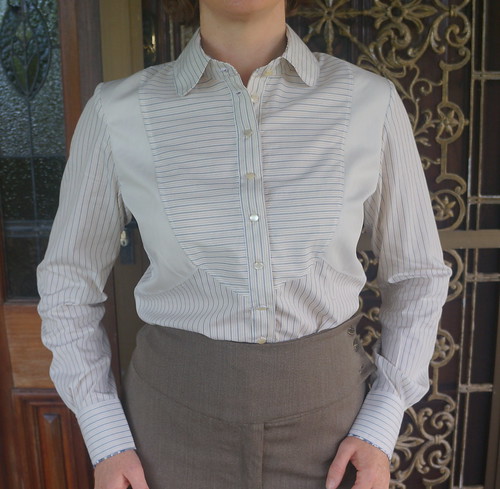
Burda World of Fashion 01-2008-107 Bib front blouse

I've grit my teeth and am sticking to my work clothes plan. I rather like the trousers (considering that they are well, trousers), they've done their duty well at work, but photos are lacking, so I shall post about the blouse of multiple fabrics instead.

DSC03407

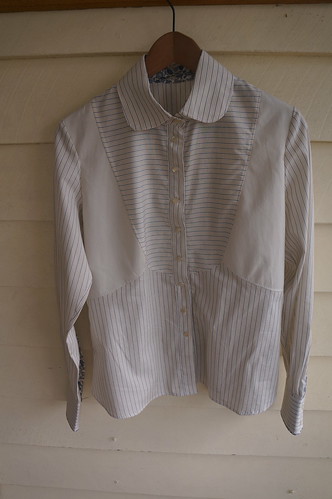
In my typical very - poor - use - of- time in an attempt to be thrifty, I was determined to make some sort of garment from a shirting remnant (man shirt), and thinking of the fabric squeezing possibilities inherent in a blouse with 8 pieces in the front, actually had a workable arrangement for this rather interesting take on a business shirt, Burda Style 01-2008-107.


technical drawing from www.burdafashion.com
 I've made this before (with the collar from 108) using different stripe directions for the front and find the effect quite pleasing. (The FBA method and other alterations I used for this garment are shown at the post about the previous blouse )
Naturally, I needed a little help from another fabric to get a whole blouse from my remnant, but as I often make contrast collar stand, cuffs and plackets, for work shirts, I didn't see this as a problem

Unfortunately, in an unusual burst of enthusiasm for cutting out (usually I make one garment before starting the next one), I was cutting out blouse the first from my 6pac at the same time, and surprisingly having a largish rectangle of my striped shirting cotton left over, I cut out cuffs and collar stand for my cream blouse and patted myself on the back for using up every last piece of the remnant.
I'm sure you can fortell the next stage of this story.
DSC03411
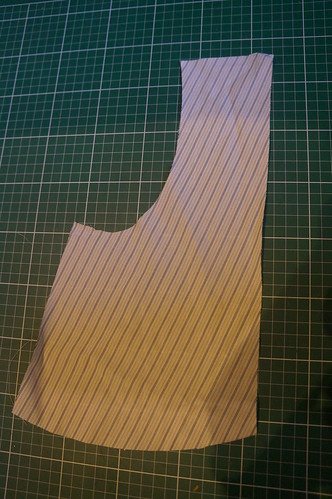
Yes, I had only cut out one of the upper side pieces. This was cut in a single layer, so as to have the stripes in opposite directions for the 2 sides. When I carefully went through casually checked the pieces of the shirt, pinned to their pattern, prior to cutting out my extra cuffs, I failed to notice that there was a singleton.
The partially completed bodice lay around on my sewing table for a few days looking at me mockingly.
I wasn't keen to use the same fabric as the collar and cuffs, this being a bit strong in contrast, but having 3 fabrics in the blouse was making me think that the blouse would read "weekend cheerful and colourful patchwork" rather than "professional with a touch of whimsy".

Eventually, I went with a solid off-white, in a cotton herringbone twill (shirt weight), which has enough of a stripe effect to give me the directional variation I was after.

DSC03409
It is not a disaster, but I'm not sure if I like it as much as my original plan, there is something rather noticeable about it for a work blouse.

DSC03405

My other design changes to the pattern  were to offset the cuffs again, for a line of contrast from the right side, to add more buttons to the front fastening for gaposis resistance, and also an inverted pleat at the back, sewn down at the top and waist, to ensure room for arm movement with minimal untucking.Instead of the complex half chesterfield front with an added tab, (which was fun, looks good but used a lot of fabric and required fiddling) I have used the most simple form of sewn on placket - a long strip folded over, with self fabric as interfacing. I have used a David Page Coffin sleeve placket pattern and instructions from Shirtmaking.

DSC03408

Seams are flatfelled, for garment longevity and inside tidiness to be visible when the sleeves are rolled up, and I have used flat buttons on the cuffs instead of the shank ones at the front, to reduce catching.
It should be very practical and useful, and there is another blouse from the same pattern cut out and ready to go.


Unfortunately I have a sudden urge to sew chiffon and ruffles.

Scrapbusting statistics about 1.3 m of shirting remannt (Global Fabrics, Wellington 2011), and a few cm of 2 other cottons - herringbone twill from Michael's fabrics and unremembered location  for the floral.


Monday, 26 May 2014

Burda Style 02-2009-120 tunic blouse.

Thank you for the encouraging comments about Project Formal. Unfortunately, I cannot indulge myself with constant evening dress sewing, and have returned to the everyday sewing with my efforts over the weekend.
I am so grateful for sew-a-longs. I have the greatest difficulty in motivating myself to make clothes for work, because my work is not the place for sartorial self expression, and I have to wear trousers. Urgh.
The Fabulous Dr E has a seasonal sew a long of 6 pieces hosted at Stitchers Guild, just perfect for a work wardrobe update.These useful pieces are deadly dull, but will get a lot of wear. I am making 2 pairs of trousers, 3 blouses and a very easy knit fabric cardigan top. Hopefully these will all co-ordinate.

DSC03387

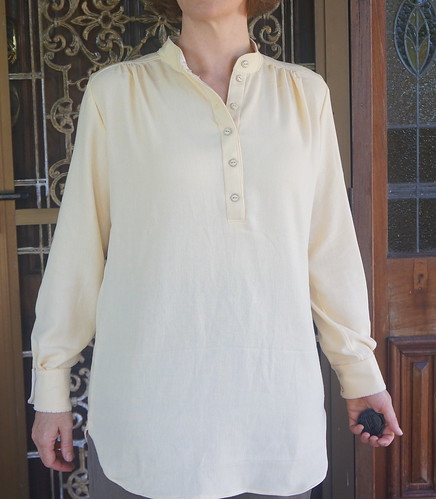
First up is a pattern I haven't tried before, the tunic blouse from February 2009 Burda Style, 120.

technical drawing from http://www.burdafashion.com
 A particularly pleasant aspect about using these older Burdas (aside from my natural tendency to sew clothing that is 5 years or so out of date) is that the pattern sheets have only half the number of patterns on them as the current issues, so they are really easy to trace.
It looks terribly casual in the photo above, but the intention is to wear it tucked in, this untucked photo is to demonstrate the length of the tunic (longer length B). The fabric is from deep stash, pre 2008 Martin & Savage Fabric, from the days when I was experimenting with allegedly breathable polyester woven fabrics for work wear (heavily pushed by Australian Stitches Magazine at the time). This will definitely be a winter only blouse - the weave is soft and loose, and the fabric is quite fine, but my previous experience with this type of fabric is that it is quite warm to wear if you live in the subtropics.
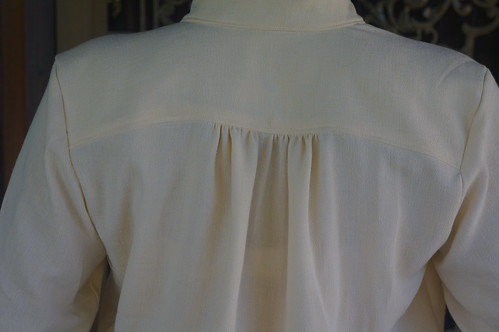
The blouse was nicely drafted, and not tricky to sew, having gathers rather than darts. I did not have to do a FBA, yay, but made my usual square shoulder adjustment, large arm adjustment and also removed 2cm from the shoulder seams as, unusually for me with Burda, the shoulders were too wide. It has gathers at the back too, making it very practical for reaching forward.

DSC03386

In an attempt to workify this casual looking blouse, I used a shirting fabric for contrast inner placket, inner collar stand and cuffs + binding.

DSC03393

 I offset the cuffs so the stripe shows as a border.
DSC03381
Burda is somewhat terse with the front placket instructions, and the two previous reviewers of this pattern both mentioned this as a difficulty, so I took photographs of this section of the construction.

DSC03349

Cut front opening to within 1cm of the marked line, sew each placket to the front, stopping at the end of the line- ensure sides match.

DSC03350

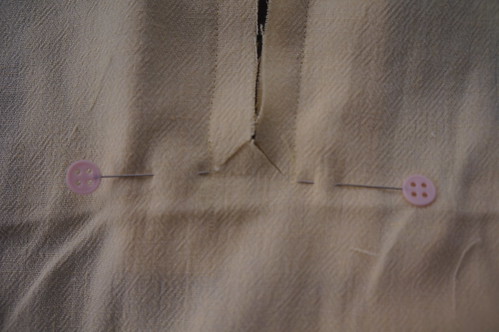
Cut diagonally into the corners at the base of the front opening (you can sew across between the two vertical seam allowances for reinforcement)

DSC03351

DSC03353

Turn plackets to the inside, laying one over the other, turn seam allowance at base of placket to the inside, making sure the outside of the placket is straight - pin in place

Finish insides of long edges (I handstitched)

DSC03354
Secure seam allowance of bottom edge to plackets (I handstitched)
Finish short edges of placket (I handstitched)
DSC03355
Sew across short edge on the inside, ensuring that seam is straight and that there is no gap where the seam meets the long edge seams

DSC03394

Turn out and topstitch as desired. Make buttonholes and attach buttons after collar stand is finished.

DSC03379

Blouse tucked in for work.

DSC03391

6pac so far
I will report on the trousers later.


 Stashbusting statistics - 1.5m woven polyester - pre 2008. Alas, there is a sizeable piece remaining.


Saturday, 17 May 2014

Self drafted trousers Mark 1

I have always scoffed at articles that say things like "trace off your best fitting RTW trousers" because no RTW trousers have fit me since I was 13 years old.
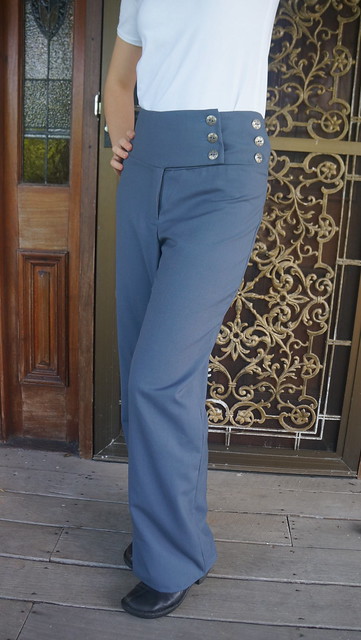
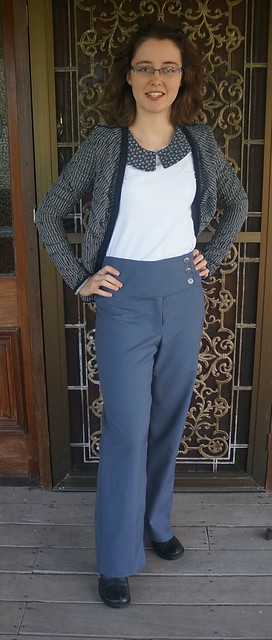
However, I am still wearing to work a pair of RTW trousers that I bought in January 2008. These required 2.5 hours of alterations (which I didn't get around to until 2010) and started me on the decision to never buy trousers again, but actually are clearly  not so bad (considering that I loathe sewing trousers for myself) - once altered, that is. I really like the wide side buttoning yoke, which I keep looking for in my Burda magazines, but have not come across yet, so I had to eat my words and trace over my RTW trousers to try to replicate them (unsurprisingly, despite being an iron-like poly blend, they are finally getting a bit worse for wear.
DSC03247

Ta-DA
Clearly that is not me in those trousers. I cunningly cut them out from some truly ancient fabric (purchased under duress (that would be me under duress) from a fierce elderly lady of my acquaintance who knows both that I sew and that I am incapable of saying no) that was full of moth holes. (Lincraft brand wool - that shows you how old it must be!)
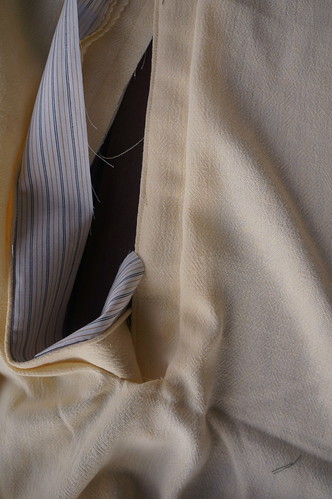
The cutting out involved careful moth hole avoidance, and did not allow very large seam allowances. The trousers fit me quite well considering these limitations, but did not exactly allow room for anything so inelegant as the physical demands of my job, so I remade them for someone more slender. They do not fit perfectly, but neither of us care very much. They Will Do (clinical wardrobe requirements for Uni are now up to 3 days a week, and one of the tutors does not approve of skirts for some strange reason)

DSC03240

The recipient did not like the waistband buttoning near the side seam, so I shortened it, but she wanted the buttons left for decoration. OK, anything really, to get these out of my sewing room. I was pleased that I had cut them extra long and was still able to do a blind hem.
The trousers are lined with imperial batiste, and fortuitously, co-ordinate beautifully with her previous work wardrobes.
I have cut out a new pair for myself from non-motheaten fabric with bigger seam allowances :).

Stashbusting statistics, approximately 2m of 30 + year old wool fabric (guestimate, I've had it for about 5 years) and 2.5 m of cotton batiste} No scraps other than those in the bin, yay!