Showing posts with label BWOF 8-2009. Show all posts

Friday, 29 January 2010

Burda World of Fashion 08-2009-121 skirt


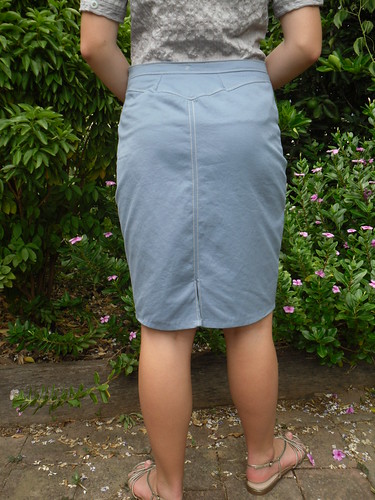
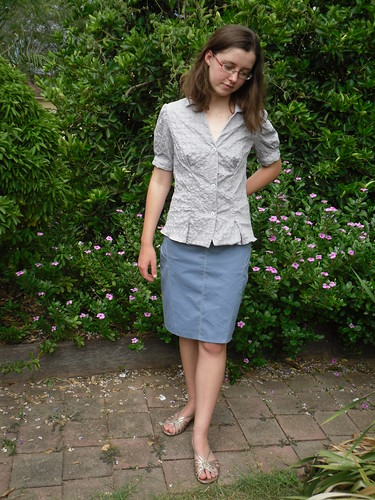
Just ignore the blouse. The garment I have just made from the August 2009 Burda magazine is the skirt. (technical drawing from Burda website) It has a side zip and a back walking ease opening not shown above, I think the most fun thing about this pattern is the front shaping and hip pockets.
I had some trouble with this skirt. The reviews for this skirt at patternreview seem a bit lukewarm to me, reporting a very narrow fit at the hips and some other fitting issues. However my difficulties with this pattern were quite different.
I found the hips on this skirt to be huge. I took fully 2 inches from the hips and more from the waist for size 38 on my daughter. To be fair, my daughter has slim hips but a generous backside, considering her BMI of 18, but 2 inches is a lot more than I usually need to remove. It is not so unusual for me to take in the waist for my daughter's clothes, but after removing 3 inches, the waist is still rather large.
SDC10115
I think I may have made a mistake in my tracing of the front waistband. Even after removing 2 inches from the hips, and 3 from the waist of the skirt body, it was too short.
I had trouble making the front pockets sit nicely. Dawn's review of this skirt suggests that the front pockets should be caught in the center front skirt seam as a stay, but the pockets on my version were not close enough to the centre seam for this to occur.

Possibly my fabric choice is not wonderful. I used cotton twill (gabardine) from Michael's fabrics, and it may be a little too light, and a little too stiff, for this skirt.
SDC10112
My other fitting changes included adding darts to the back yoke. Unfortunately this fabric shows the outlines of the tucked in blouse. Maybe I should have lined it.
SDC10114
However, worn with a blouse over the waistband, this is quite a flattering skirt, and having no lining makes it cool to wear.
SDC10127
I am tempted to make this again in denim for a more casual look.
SDC10110
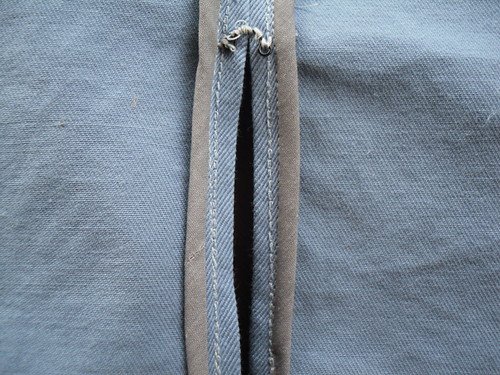
One new thing I have tried with this project is the addition of a stretched out metal eye to the top of the walking vent. I thought I saw this in either the most recent issue of Threads or of Australian Stitches, but a brief flick through these magazines is not showing me this tip. The story is that it will prevent the back seam from undoing. I will see how it works.

Tuesday, 26 January 2010

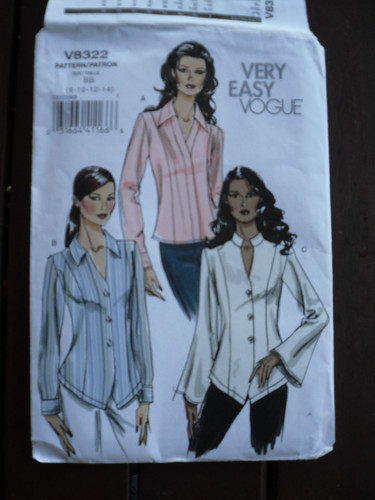
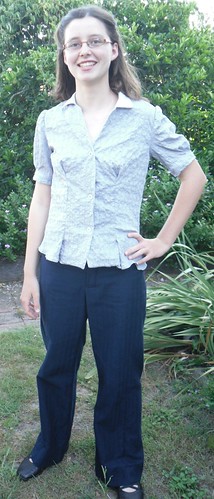
Another BWOF 09-2008 Frankenpattern blouse/ Vogue 8322

SDC10069
The next SWAP blouse was originally to be Vogue 8322.
SDC10044
However, I was not really keen to fit this princess line blouse for my daughter, especially as the fabric earmarked for the next blouse was a crinkle stretch cotton blend, which is not the easiest fabric to sew. I wanted to keep seamlines to a minimum.
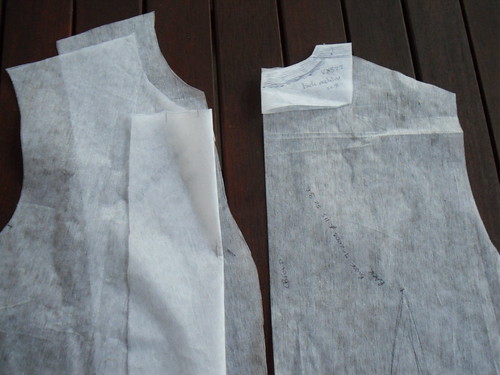
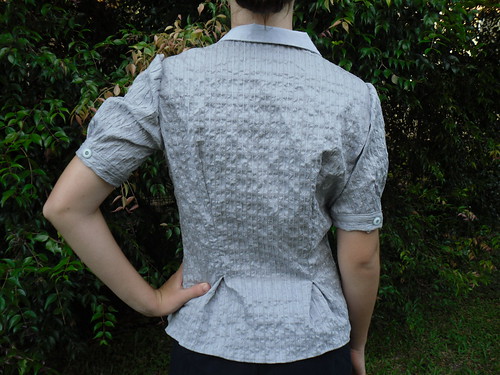
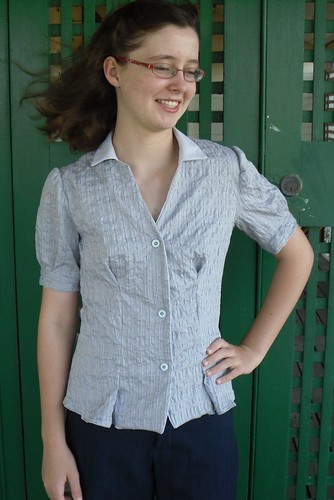
Instead I laid the size 8 neckline and front of view C from the Vogue pattern over the BWOF 09-2008 pattern for the blouse that I made earlier. I lined up the centre front lines, and thought hard whilst I was cutting out so as to remember the difference between the non-seam allowance and full seam allowance pattern pieces. The sleeve is 09-2008-126 again,this time constructed with the pleats, placket and cuff as shown in the magazine.

SDC10040
I was not fully confident about the back neckline, as although the length of the 2 pattern pieces was the same on the stitching line, the shape was different, but I decided to try it in the BWOF shape with the Vogue upright collar and see how it went.
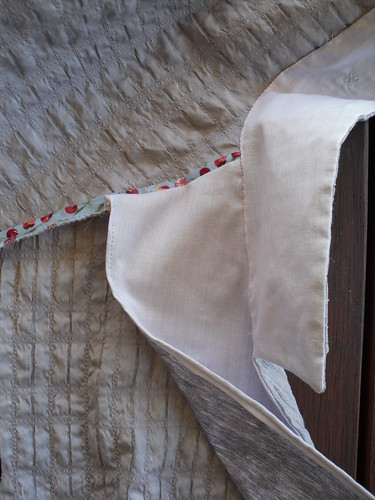
The upright collar was not a success. It is too high, and looked nothing like the line drawing. This could be a) my different back neckline b) the stretchy, crinkle fabric or c) the pattern. Fortunately, both my daughter and I like the collar worn turned down, even though this shows the different facing fabric.
SDC10052
The different facing fabric is one of the strategies I attempted to minimize the inherent problems of sewing crinkle fabric. I was not able to match the colour of the grey crinkle fabric exactly, but fusing dark interfacing to pale lavender batiste made a toning shade to the grey, and a firm fabric base to use for the front facings and collar. My other crinkle fabric strategies were to sew woven selvage to the shoulder seams for stability, to bunch up the sleeve fabric when sewing the armscye, and the hem, to minimize rippling, and some retrofitting at the shoulder seams, front tucks and side seams once the garment was sewn as it was a little too large due to the fabric ease.
SDC10043
Unfortunately this fabric does not photograph well. The lycra in the stripes gives the fabric a subtle sheen, which reads as overall shiny through the camera. In real life this is a much more matte fabric than it looks on my computer monitor.

SDC10104

Materials cost: Fabric: 1.3m cotton blend crinkle fabric from Sckafs fabrics, $26, batiste, about $2
Pattern: Vogue 8322 from USA, about $11 inc postage
Buttons: 5x 65c, $3.25
Interfacing and thread: $3
$45.25

....................................................................................
Answers to questions and responses to comments from previous posts

The Slapdash Sewist asked re BWOF 09-2008-107 "Is it comfortable to pull on and off? Wovens without a button front seem like they'd be too constricting."

The blouse is made of an extremely stretchy, stretch woven. As Claudine commented, this stretchiness makes the blouse easy to pull on over the head, although it is fitted. My daughter finds it quite comfortable to wear. I was actually able to try this on myself, to get an idea of the shape on me, even though I am quite a bit larger than my daughter.

Neighbourhood gal asked "What kind of work does your daughter do? She looks so young to be working."

Queensland is the only state in Australia to not have an age minimum for employment, although there are restricted hours for workers of school age. The minimum age for employment in other states is 14 years and 9 months, which is less than my daughter's age. There are exceptions for some jobs, such as newspaper deliveries, and for family businesses. My daughter carries out reception and administration tasks in one of our family businesses, for 2 hours, twice a week after school, and as a relief worker for the vacations of other staff in school holidays.

Gail commented "Your daughter has amazingly sophisticated taste for a young girl. My dds are all jeans, t-shirts and mini skirts.

Our business has a strict dress code. I wrote it :). My daughter wears t shirts, shorts and sundresses at home. These are work clothes, and she selects them according to the dress code, which is rather limited.

Patricia commented Did you know that there is a lovely little sewing tool called a "Sharpie" It is a permanent felt tip marker with a fine point? The intended use of which is to tone down/alter thread mishaps such as yours. I have them in a huge range of colours. It might be worth a try if the thread colour continues to bother you."

This sounds like a great tool. I have not come across Sharpies locally. Does anyone know where I can buy these in Australia?

Thank you for all your comments and questions. I really appreciate the feedback.
Karen

Monday, 25 January 2010

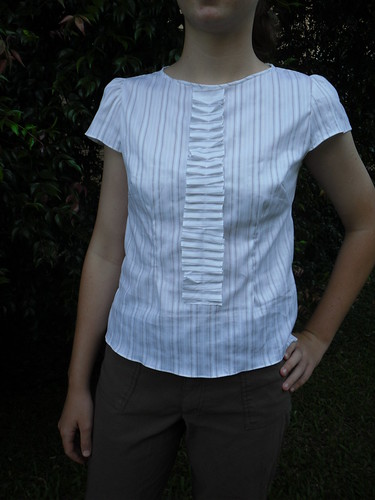
Burda World of Fashion 09-2008-107 blouse trial


technical drawing from Burda
Whilst tracing out the previous blouse from the September 2009 magazine, I noticed this little pattern for a t shaped woven top. I think this has definite remnant using possibilities. I could not think why I had not noticed it previously, but when I saw that it was disguised by a sequin covered fabric in the photo shoot, I understood my oversight. There is not much call for sequins in my family's wardrobe.
The pattern calls for 80cm of 145cm wide fabric. I used a 70cm remnant of polycotton stretch woven that I have been avoiding for some years. It is rather cheap looking fabric, originally bought for a shepherd's costume in a nativity play. (Back when 70cm would have been mid calf length for my little ones)
This was plenty of fabric for a size 36 top. I had enough left over to attempt a pleated ruffle in imitation of nearly every blouse I saw in David Jones at Toowong last week. I was aiming for a triangular looking ruffle, but did not make the angle sufficiently steep.
SDC10031
You can see that my blouse is not quite the same as the technical drawing. It may be my very stretchy and badly behaving fabric, but the sleeves on my daughter's blouse definitely needed gathering, not easing, to fit between the marks. My daughter likes puffy sleeves, so this was not a problem.
You may also notice the additional front darts. I find them rather noticeable. Did I mention that I did not like this fabric? This is a very boxy pattern. I could not fix this sufficiently by taking in the side seams and back darts, so added a few more darts at the waist. I also made a small bust adjustment, and raised the bust point for improved fit.
SDC10033
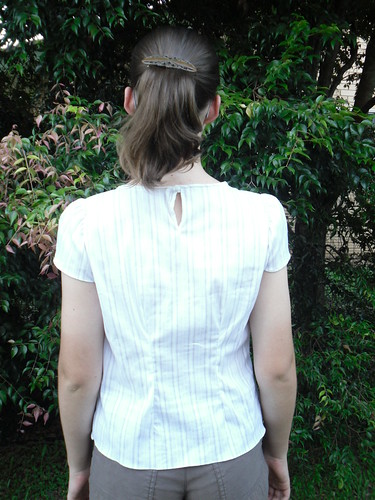
The neckline and armscye are finished with bias binding. I made a loop with the neck binding instead of a thread loop, and made a placket for the back neck slit instead of having a centre back seam and using the seam allowance to finish the placket.
This was a successful trial run for the pattern, and my daughter will probably wear this version to work. I am sure I will make this again.
Materials cost :Fabric $7.50 (still had the remnant label attached) from Pizzaz Fabrics. Pattern - magazine already used, free, thread call it $1, recycled button
=$8.50.

Saturday, 9 January 2010

Close up of finessing and finangling

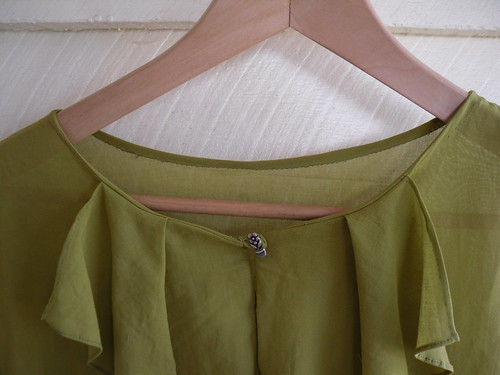
The Slapdash Sewist has asked me for close ups of the 8-2009-117 blouse neckline, which I finished with a bias strip. This is not very neat work, but I am prepared to show it for someone with such a delightful blog, and a profile which I wish I had thought of first.
"..there are a lot of details that can be fudged, finessed, and finagled. I am all about the latter."
This neck finish is in that spirit.
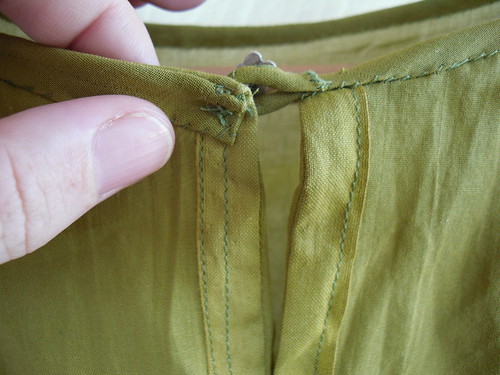
SDC10674
The stitching shows a little from the outside
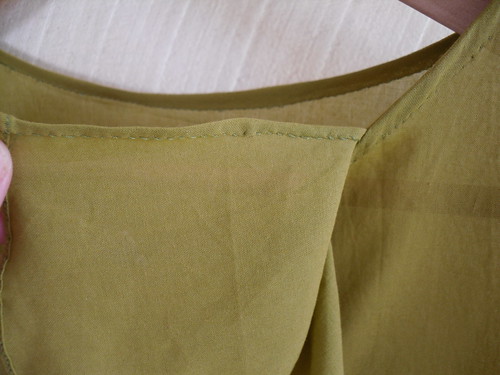
SDC10675
At the front neck opening, I turned back the selvage seam allowance and stitched it down by machine. This is covered by the flounce at the outside.
SDC10676
The neckline stitching is also hidden under the flounce. I am sure this was an easier than Burda's facing, and for a quick summer blouse, it will do!

Friday, 8 January 2010

BWOF 8-2009-117 blouse

I borrowed Trinny and Susannah's "Body Shape Bible" from the library yesterday, and although I am not sure why they think nearly everyone with an hourglass figure is overweight, I think they make some good points about clothes suitable for this figure type.
One point that I had trouble with was "Never wear blouses with bows or flounces". Particularly as I had just cut out blouse 117 from the August 09 Burda magazine


Technical drawing from burda.com
I have a weakness for ruffles and flounces.
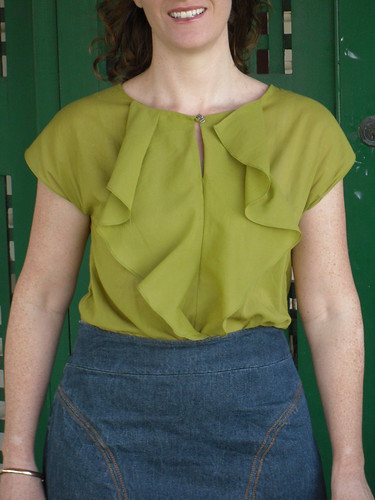
I don't think it looks too bad, although maybe not my best look.
SDC10664
I took a bit of trouble with this project. The first thing I did, as I do know that boxy styles do not do much for me, was to add a side bust dart to the pattern.
SDC10643
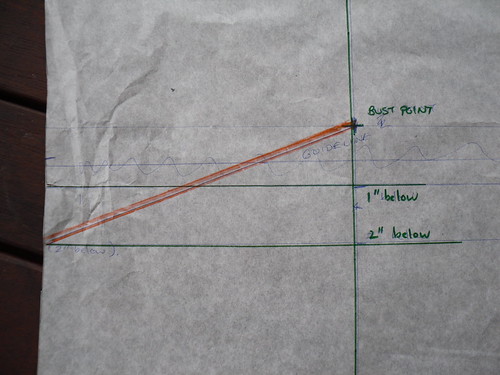
I used the instructions from my Taunton Press book "Fitting solutions". First I found my bust point on the pattern by holding the front pattern piece up to myself ( I made a mistake here, and the dart ended up a bit high, but you can ignore this). Next I measured 2 inches vertically from this point, then drew a horizontal line to the side seam line. Then I ruled a guide line from this point on the side seam, to the bust point. At this point I found the instructions a little vague, but eventually worked out that the dart should finish 1 inch from the bust point, along the guide line.

SDC10645
The next stage was to draw in the dart, with the legs starting equidistant from the guide line. I could have worked out the dart mathematically, but instead held the fabric up against me and pinched out the excess fabric to give an idea of the dart size required. I then drew this out, folded the dart down, and recut the side seam with the dart folded to allow for sufficient fabric at this seam.
Adding the dart stopped the blouse from being completely shapeless. I did need to raise the armhole marking by 2cm, as before this change it was in the dart, and I am glad I did this, as the armscye only just covers my under wear.
Next I considered the finish of the flounce. The Burda instructions tell you to use a narrow zigzag to finish the edge, then turn this under and zig zag from the right side. My sample following these instructions is on the left. In the middle is a machine rolled hem, and on the right is an overlocked rolled hem. I decided to use a machine rolled hem.

SDC10646
Unfortunately, I failed to remember that, following the Burda instructions, I had added a 1.5cm seam allowance to the flounce. Naturally I did not use all of this for my rolled hem, so the flounce is a little bigger than it should be. I could not manage a neat machine rolled hem for the top edge of the flounce, as the corner gave me trouble, so I did this part by hand.
My other change was to use a bias strip to finish the neck, rather than a facing. I doubled the strip and machine sewed it to the right side of the neckline, then turned it over fully and hand stitched it. I extended the right side of the strip to make a loop, rather than use a thread loop for the button as Burda instructed.
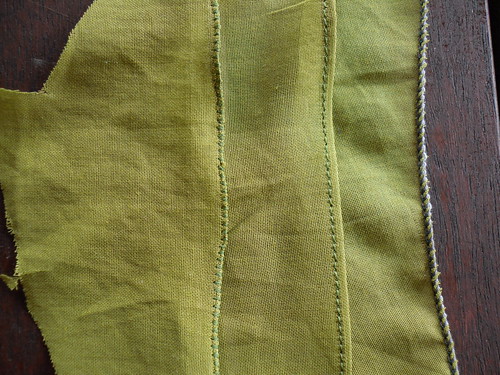
The fabric is almost the last of my pale olive green voile from Oh Sew, Noosa, there are only scraps left.
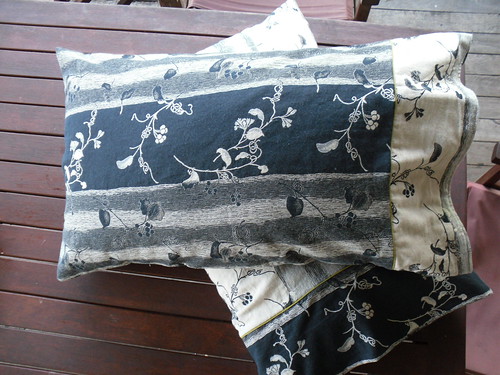
Just to use it up - and the half reel of navy thread from my daughter's trousers, I sewed some pillowcases from another fabric Sharon brought me from Japan, using the green as piping. I could not imagine myself wearing a garment from this reversible thick cotton fabric (the stripes again I think), but it makes pretty good pillowcases.
SDC10673

BetsyV asked me if I planned to make the 12-2009 trousers for myself. I do, but the thought of the fitting is putting me off. My daughter has long legs, is a dancer and is not yet 15 years old, so the small sway back, waist decrease and backside increase adjustments that I make for her don't give me too many hints on how I should fit for myself. However, she does not have a skinny, flat backside, so I think the flattering cut on her could be similarly flattering on a more generous figure with curves.
Sewing is about to come to an abrupt halt here. The weather looks to be clearing up and camping is on the agenda again. - Elizabeth and Janine, I am on holidays at the moment, so have spent hours every day doing just what I like - sewing!