I have a weakness for heirloom sewing. Lace, pintucks, fussiness, all appeal to me greatly, so when Burda reproduced a 1950's fancy blouse pattern in the March 2013 issue, I could not resist.
However, I am aware that both retro and heirloom look more appealing on a young woman, so rather than make this as a dowdy
old unfashionable middle aged lady blouse for myself, I chose to make this retro blouse for my older daughter, who thankfully shares my weakness for lace and fol-de-lols.
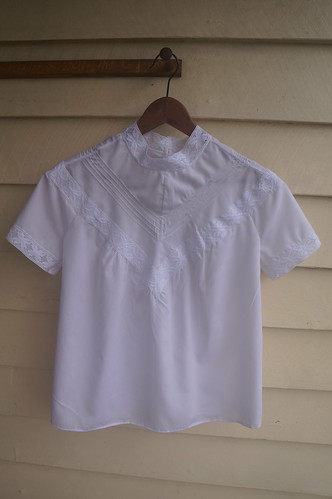

The blouse gave me a few hiccups.
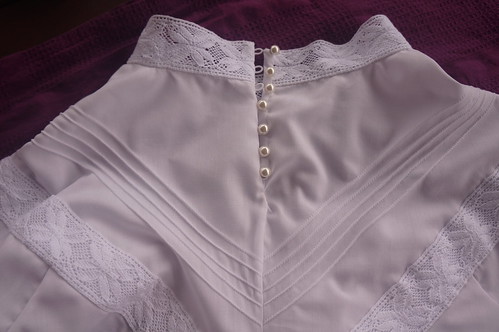
When I cut out the blouse, I was a little concerned about the grain direction of the upper yoke .In the heirloom sewing with which I am familiar, pintucks and pleats are carefully aligned with the grain of the fabric. Burda, however, places 3 pintucks on about a 30 degree angle off the straight grain in the upper bodice.
Unsurprisingly, these pintucks disorted the fine batiste fabric considerably. Presumably, my inability to stick with 3 stingy pintucks exacerbated this distortion. 5 is my magic number for pintucks- unless I use 7 ;)
Here is the unaltered blouse with pintuck distortion running rife.
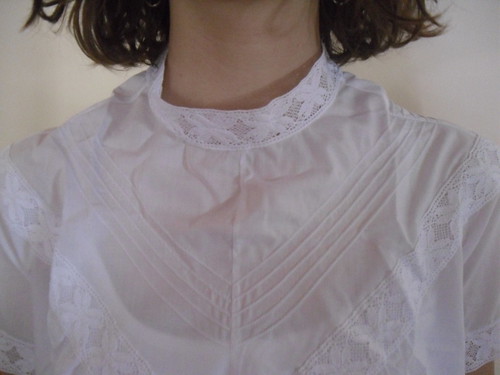
Here is the altered blouse with removal of 1cm from each upper bodice piece from the neck, tapering to the shoulders
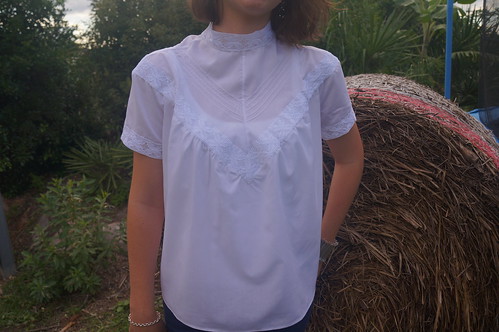
. There is still considerable excess pouf, but I am happier with this iteration. I wonder if the fashion for 1950's sloped shoulders added to my fitting issues - I usually make a square shoulder alteration for my daughter, and thought I had done this when cutting out the pattern, but had to make a further square shoulder alteration as retrofitting.
This is a very pretty blouse. I did not have 5.5 cm wide lace with a scallop border, but it is just as pretty with slightly skinnier lace with and endreteux border in my opinion, particularly as I had this particular cotton lace lurking in my stash..
If I make it again, I would alter the grain of the upper bodice pieces so that the pintucks are either on the straight or cross grain.
Although this is a 2.5 dot pattern, the amount of handsewing required for this pattern makes it rather time consuming and more tricky than most 2.5 dot patterns in Burda.
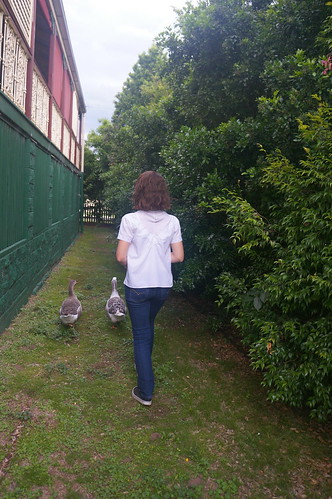
I added to the time consumption by using french seams throughout, and handsewing all of the lace to the blouse. In my opinion this level of attention to seam finishing is necessary for a translucent garment.
I also used a skirt type placket for the back neck, rather than simply turning under the edges of the fabric - batiste needs a few layers before applying buttons in my opinion.
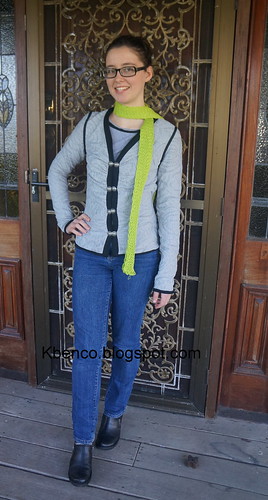
I found it rather amusing, that without viewing the magazine photo, my daughter styled this blouse with a cuff bracelet and skinny jeans for the mandatory hand-it-over photo shoot.
I think she is on trend.
Burda model photograph
Stashbusting: 1 m of cotton batiste 2009, 2.7 m of cotton lace, 2000.