Sunday, 29 June 2008

BWOF June 2008, top #124

I made the first item from my Burda subscription today. I have written a review at patternreview. My husband does not like this top, but I think I will still put it in the June Capsule unless my sewing speeds up dramatically. I think Burda sewing will be another new fitting journey. Just what I need!
ETA link to my review of this top

Friday, 27 June 2008

Viyella dress

 
My SIL just sent me this photo of my niece in a dress I made for her first birthday in September 2007. I have not written about it before, so am indulging myself by putting it up here. The dress is made from a Viyella print that my MIL gave me. It was originally bought to make a dress for my SIL, so is about 35 years old. My MIL was very pleased that I had put it to use for the next generation. I was thrilled to have such beautiful fabric with which to smock. The texture is fabulous. I used a very simple smocking design as the print is quite busy.

Recently Marji, of blog Fiberartsafloat generously gave away 50 items from her stash. I was reading her blog late at night, and weakly succumbed to fabric lust when I saw that she was giving away a piece of Viyella, and asked her for it. I wanted to make a smocked dress for another niece, belonging to my other SIL. The fabric is grey, and I had visions of this dress made up with long sleeves (Marji's Viyella is heavier), white collar and cuffs, and smocking in shades of pink. I ran this idea past my SIL, and unfortunately it did not get very far. I feel very responsible towards this piece of fabric. Marji tells me that it is about the same vintage as my previous Viyella experience and I am sure it is time it came out of stash mode, so I am thinking quite hard about other possibilities. I really want to smock this fabric.
Posted by Picasa

Wednesday, 25 June 2008

McCall's Layette 7367, pattern morphing to meringue dress #2


After I made the meringue top for my daughter, I received an enthusiastic email from my SIL about the inspiration dress on JC Crew. Of course, this meant that I needed another pattern, and I do have baby raglan patterns. This McCall's layette pattern is possibly my most used pattern. I bought it when I was expecting my first baby, and have made dozens of the nightgown/daygown in size preemie (fits a 7lb newborn beautifully) and newborn (fits a 6-12 week old). I think I have made every piece at least once, can make the nappy cover in my sleep (or after that pesky 3am feed which ensured I was up for the day - or is that the same thing? a skill I achieved after the 50th version) and have made lots of hats and leggings as part of baby gifts. The pattern is for knits only, but I have successfully made the gown many times in woven cotton, so did not anticipate any trouble in converting the pattern to a woven baby dress. This time I have made 2 ruffle dresses, one for my youngest niece, whom is about to turn 1, and another in newborn size for another niece whom is expected to appear in September.
 
Essentially, I used the method described by Lyra in her post on the children's board at Stitcher's Guild. I cut out the front and back around 2 inches from the fold for the newborn size, and 3 inches for the 1 year old size. I also cut the neck 1.5cm lower for both dresses. I then pleated the garment back to slightly smaller then the original pattern piece. I pleated it smaller as the original garment is gathered slightly at the neck by the ribbing neckband. I also altered the pattern by moving the opening to the back, and finishing this with a bound placket. The dress closes with a button and loop. I have made the 1 year old dress to more of a tunic length, as crawling and learning to walk are easier in this style of garment. I plan to make coordinating pants for my niece to wear underneath.
 
Here is the finished new born size dress. I have pleated the lower sleeve as well, bound the neckline and sleeve hems with bias, and finished the skirt with a rolled hem. Bias cut batiste ruffles are cut to 3x the diameter of the hem and the neckband, finished with a rolled hem, sewn in a circle for the hem, gathered and sewn down the middle.
I think this is my new favourite baby gift. I hope everyone has girls!
Posted by Picasa

Monday, 23 June 2008

How to draft a simple raglan sleeve top

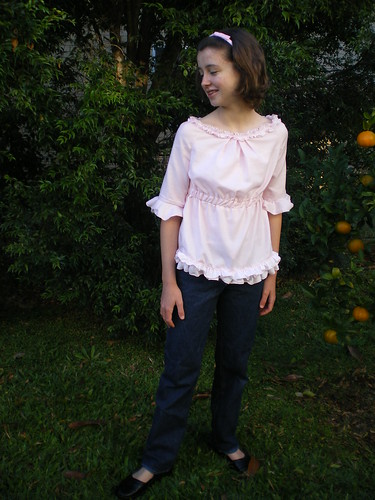
I made this top for my daughter after Lyra posted at Stitcher's Guild about the inspiration for a raglan sleeve dress with ruffles that she had made for her niece. It seemed to me, that I could modify the bishop style chemise I had recently drafted in order to make a similar top for my daughter. I was very anxious to make something girly after all that black and grey polar fleece man and boy sewing, and even more anxious to have a rest from the fitting issues with the V7903 blouse. The wonderful thing about drafting in this draping manner is that the garment has to fit, and the even better thing about this style of top is that it is supposed to be loose.
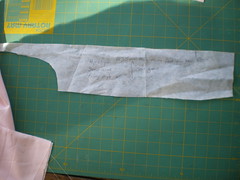
This is the "pattern piece" I have drawn after measuring my daughter and deciding how loose the sleeve should be, and where I want the neckline to sit.

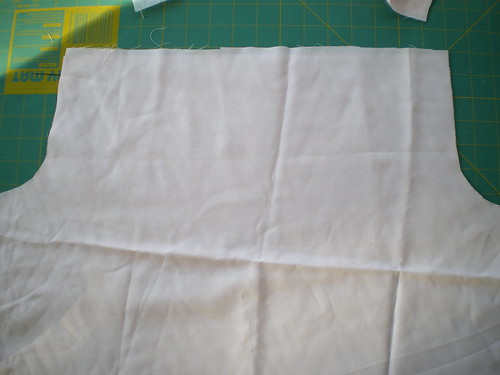
Above are the two main pattern pieces, front and back are the same, and the sleeves have the same curve, but are more narrow.
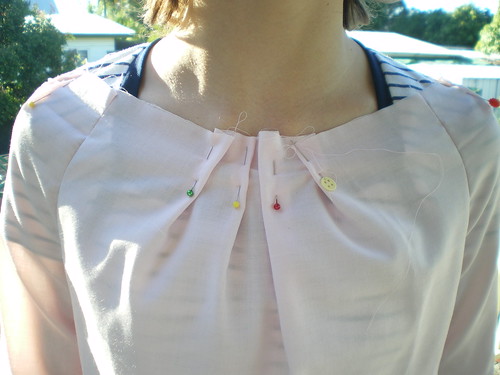
I sewed these pattern pieces together as a first step. To make the garment fit, I added inverted pleats to the front, back and sleeves, centring the pleats in each piece of fabric. I draped this directly on my daughter (the t shirt is so there can be photographs). Now Blogger does not want me to post any more photos, so I will describe the rest.
I marked where we wanted to gather the garment below the bust whilst the garment was on my daughter. I wanted this to be very simple to construct, so made sure that she could pull it off over her head before basting the pleats. I added the casing for elastic first, it is around the lower ribs for an modified empire line effect, rather than a maternity look.
Next I bound the neckline with self bias binding. I stretched this slightly as I applied it.
The next step was to add the ruffles. The main garment pieces are made of a lightweight cotton twill, but I was fortunate enough to have imperial batiste (65%cotton, 35%poly) in the same shade, which made the ruffles more delicate. I cut a series of wide bias strips, length 3x the diameter of the blouse for the bottom ruffles, and one narrow strip, 3x the diameter of the neckline, for the ruffle here. I stitched the pieces together in a large circle for the top and for the bottom, then finished all the edges with my new rolled hem foot on my overlocker. This is the first time I have used it and it was terrific!
For the hem ruffle, I gathered the ruffle twice. First I ran two rows of gathering stitches down the center of the bias strip, and pulled them up to roughly the diameter needed, then I ran another gathering thread 2/3 of the way across the strip, pulled this up as well, and used this row as the fold point to make a double ruffle. I then stitched the ruffle to the underneath of the rolled edge garment hem. The double gathering makes the ruffles look as if they have been attached independently, and this also gives a more sticking out effect.
For the neck, I gathered down the centre of the strip, and stitched to the seam line of the bias binding.
For the sleeve frill, I cut a circle, with the middle cut out to the sleeve diameter less seam allowance. These edges are finished with the rolled hem too. I did not want another gathered ruffle at the sleeve hem, as it is already a real Meringue top!

Sunday, 22 June 2008

V7903 blouse fitting #2blouse again

 
I finished the second attempt at V7903 this morning. This blouse has the narrow shoulder adjustment and the "sway back" adjustment that I posted about a few days ago. Unfortunately, I have made a very foolish choice of fabric. This is a crinkle cotton that has been languishing in my stash for around 3 years. I bought it because I love the colour, but had not been able to decide what to make with it. It was a real nuisance to sew, as every horizontal seam grew under the needle as the crinkles flattened out. In addition, I was unable to fiercely press the seams and darts without distorting the fabric, and when worn, the blouse expands! This will make it very comfortable to wear whilst doing housework (note that the blouse may not be allowed out of the house due to lack of sartorial elegance, well maybe to do the school run if I am desperate. I am hoping that the hems will re-crinkle after washing, as they look stretched out to me at the moment. I do not think I will try crinkle fabric again and I think it is back to the cutting table for fitting.
 
The side view really shows the problems, despite all the darts, this blouse appears to hang on the bust. I do not need all this room for my belly. I appear to have dreadful posture here, and this is all the blouse's fault.
 
The back view looks a bit funny at the shoulders too. I am running out of fixing ideas.
Posted by Picasa

Friday, 20 June 2008

Vogue 9106 Children's jacket

 
I made sweatshirts, skirts and trousers from this pattern several times when my daughters were between sizes 2 and 5, up to about 5 years ago, but had not revisited it recently. However, I have a new wonderful plan of not stashing small yardages of scrap fabric, so wanted to use the remnants from the polar fleece robe I made the other day, and the top from this pattern looked like a good option for the left overs. I made a size 4 for my son, who wears around a size 5 in RTW. This pattern runs large, possibly because it is intended to be worn over several layers, rather than over one layer, as is possible in Queensland. ( I am feeling weather superior today as I spent a beautiful warm winter day outside at my son's sports carnival, but I digress, back to sewing)
 
My son was not overly co-operative with photography. He insisted on posing only whilst on his new, not yet completed, billy cart, and you can see that the collar is not turned out. This is a great pity, as it matched perfectly. He is not inclined to have another photograph taken, so you will have to take my word for it.
I have made view A, but changed the pattern so that the top unzips fully, rather than just to the middle of the chest, as this makes a more versatile garment for variable temperatures.
 
In order to emphasise the slightly interesting construction of this top, I have used a folded over strip of swimwear lycra, grey, in the top arm seams, around the neck seam at the collar, the horizontal mid chest and back seam and also at the center front on either side of the zipper. This same fabric was used to bind the sleeve hems, rather than have a loose sleeve. I found the zip was difficult to insert without distorting the fabric. I did not want to use interfacing, so instead hand basted the zip, ensuring that the chest seams matched horizontally, then restitched in the ditch between the fleece and the lycra in order to add strength to the zipper insterion seams. The plan for this jacket is for rough play in the back yard. This was a quick, easy project, and I think has made useful play clothes. I like remnants, I feel as if I have just made some free clothes.
Posted by Picasa

Thursday, 19 June 2008

V7903 blouse fitting #2

 
I put the earlier version of the V7903 blouse up on the critique board at Stitcher's Guild, and Linda F and Nancy K, kindly commented on the fit. There seems to be something wrong with the shoulder and armscye, this being the North American term for armhole, sounds fancy! I have already taken in the shoulder a lot. When I layed my altered pattern piece over the original pattern, the shoulder and armscye were smaller than the smallest size "A", which gave me a warm fuzzy vanity sizing feeling, as I had originally cut a "B". I am very happy with the neck and collar fitting, so chose to try a narrow shoulder adjustment, rather than redraw the upper bodice of the pattern to a smaller size, which was suggested in another fitting thread at Stitcher's Guild. The narrow shoulder adjustment amuses me, as I have always thought I have very broad shoulders, however, possibly the rest of me has caught up to, and indeed surpassed them! My shoulders also tend to squareness. I do not usually adjust for this, but seeing as I was in my fitting book (above) I thought I would go the whole hog and adjust for my square shoulders as well.
 
Here is my altered front and back pattern piece. The scribble on the outside armscye is where I have already taken in the shoulders after I sewed the first blouse. You can see that I just increased the seam allowance to improve the fit in the already constructed blouse, and have just transferred this to the pattern. It is not an approved method, but it worked for me, sort of. In order to compare effects of the new changes, I am carrying over this adjustment to the second trial blouse, although I may regret this later if I have to make a 3rd fitting attempt version.
For the shoulder adjustment, I slashed (outside the dart) vertically from the shoulder, and horizontally from the bottom of the armscye, then crossed over the slash at the shoulder by the amount I wanted to take in. Then I trued the shoulder, and redrew this line with a decreased slope to allow for my square shoulders. I have cut out the blouse and hope to make it up tomorrow to judge the success of these alterations. I have not altered the sleeve again. I think there is enough ease already to allow for the very slight change this adjustment makes to the bodice armscye.
Posted by Picasa

Wednesday, 18 June 2008

Comfort sewing

 
I made this yesterday for my husband, because he has a cold. I was strongly influenced by Robin Denning, of blog " alittlesewingontheside", who made a beautiful silk charmeuse nightshirt for her daughter, whilst her daughter was unwell. This is not quite in the same sartorial category, but I thought it might help the sufferer. Once again this project is not a June Capsule item, nor is it stash reduction. I am not doing too well with my self imposed sewing commitments!
 
I have used this pattern many times, always for the robe. My husband's robe is a size large, and made of not terribly nice polarfleece from Spotlight. I have previously made the robe in size small for my daughter (waffle pique cotton x1 and polar fleece x1) and a small-medium for myself (waffle pique cotton). It looks very nice with piping around the collar in the pique cotton, but this is just about invisible in polarfleece, so I did not use it for this version. It is a quick easy project made like this, it took about 2 hours including cutting out and changing threads.
Posted by Picasa

"Mediaeval" costume


My daughter made the overdress, head dress, surcoat and shoes for her costume, worn to a Mediaeval Day at school as part of this semester's history unit. The dress started as a size 6 tracing of McCalls 5177, no sleeves. The size 6 is the smallest size on the pattern sheet, and my daughter is actually a size4, but as the fabric used is a thick, possibly home dec fabric with some relation to plush cordory, and the dress is worn over a full length, volumious chemise, we thought a size 6 would fit better than the size 4, and did not bother scaling down (The fabric was donated to my mother's quilting group, and passed on to me as it is unsuitable for quilting, and none of the members fancied it). I made the SBA fitting adjustment suitable for a 13year old, and helped with final fitting tweaking, but all the sewing other than the zipper insertion (highly non authentic!)was done by my daughter without further assistance. I am very pleased, as now she can make all next summer's dresses for herself. This pattern has princess seams and a separate bodice and skirt, so I think it is a step up for her sewing.
The surcoat is rectangles of fabric, trimmed with faux fur. The sleeves were cut to shape whilst draped on my daughter. Again the sewing was all my daughter's work. The fabric is tracksuit fleece. This was purchased by mistake. A visitor was stopping at Spotlight on the way up from Brisbane, and asked if I needed anything. I asked for 5m of polar fleece in black or blue to make dressing gowns for my husband and son, and this is what she bought. I am glad to find a use for it! The fur is left over from a once off teddy bear making project which a friend talked me into. Teddy bear making is not my thing. In fact, I did not start the project!
The headpiece is made from scraps from the surcoat, some left over braid from cushion making, and a scrap of polyester chiffon that was purchased for children's Christmas craft projects. My daughter invented this after looking at 13th century engravings on the internet. The shoes are made from vinyl that was lurking at the bottom of the bag from my mother's quilting group, we found a costume making book in the library that showed us how to make shoes from different periods, and my daughter made these as well.
My daughter was kept very busy for several weekends working on this costume. Unfortunately it does not count towards her history grade, but she had a lot of fun, and has learnt some more about sewing.
Posted by Picasa

Monday, 16 June 2008

Bishop nightdress or Mediaeval chemise?

 
My elder daughter has been studying the Middle Ages in Europe for the past semester (she is in year 8). This study unit culminates in a Mediaeval Day at school (today). The children are preparing a Mediaeval Feast, and are asked to dress in character, DD the elder is the queen. One of her assignments was on clothing of the period, and she found it very interesting. She has made most of her costume herself with a bit of pattern drafting help from me. She has made a surcot with fake fur trim (5m of horrid tracksuit fleece gone from the stash yay!), a headpiece, shoes and a cotharidie? overdress with a square neckline. She does not have time this morning to allow me to take photos of the full costume, as she is required to travel to school dressed in her regular uniform, but I will put some up tomorrow. The photo here is of my contribution - a smocked chemise.
 
Apparently there is some controversy regarding the raglan sleeves I have used - possibly only square sleevelines were used in Mediaeval times, but as the Romans could set in sleeves, I don't see why the Middle Ages should completely regress to a T style. Smocking was widely used by English peasantry by the 1300's , so we decided that a noble's dress could use this useful technique for the gathering. Really, we do not have to be too authentic for this costume day, and decided that a bishop nightie would make a pretty chemise for her costume! To my astonishment, despite my large collection of Australian Smocking and Embroidery magazines, I did not have a pattern for a bishop neckline in my daughter's size. The closest were a girl's size 10 in "The flower seller" and a women's size 10 in issue 33. I have made the women's size 10 previously, in a nightie for my Mum, so I know that this pattern is very large, more like a women's size 14. What I ended up doing was scaling up the girls size 10 to a girl's size 16 from the "flower seller" pattern, which runs true to the measurements printed in the magazine, although these are larger than general RTW girls sizes in Australia IMO. This pattern calls for doubling over the top hem, and pleating through the 2 layers in order to later use this layer as a casing for a drawstring neck. This seemed like a terrific idea until I tried to pleat through 2 layers of this fine, but very tightly woven cotton fabric. I broke 8 needles on 3 attempts, a new record I think, then decided to pleat in a single layer only and had no trouble at all. I have previously made "the flower seller" in batiste, girls size 7 and had no difficulty at all in pleating the two layers.
 
I made up the smocking and embroidery as I went along. I have smocked this with cable, then a cable wave combination followed by a 5 step trellis diamond pattern at the neck. I have graduated from deep pink, DMC 222, through DMC 223 to DMC 224, using 3 strands and substituting one strand of the lighter colour in each row. The increasing elasticity of these stitches allows the pleats to fan out at the neck and sit nicely. At the sleeves, I have repeated the cable wave combination over 2 rows, graduating through DMC 222 and DMC 223 in the same manner.
The front placket is faced with another layer of the same fabric. I have fastened the neck with a pewter rose button and thread loop, and embroidered the placket with a fanciful climbing pattern of bullion rosebuds and roses, in the same 3 shades of pink DMC thread,(and dull green for the vine and leaves) , using 2 strands. The vine is in stem stitch, with calyx in flystitch, leaves in detatched chain. I tried to pick colours that would have been available in natural dyes, but have undoubtedly cheated!
Posted by Picasa

Thursday, 12 June 2008

Travel wardrobe

 
Last night I was packing for my daughter's trip to France, and decided to put the wardrobe up for display like the SWAPS, just for fun. The photo above is the items I have made. The photo below is the purchased items she is taking. However, I had her try on the purchased long pants, which she has not worn since last winter, and they are too small, so we have substituted a pair of khaki 3/4 pants. The wardrobe has only 3 items that do not match ablsolutely everything else - the striped tank top, the print blouse, and the print skirt. However, I think she needs the patterns for a less uniform look.
 

The last 2 items I have made for her are tank tops/vests from Simplicity 9461. I made these a little longer. The beige tank has a contrast border, sewn double to the right side, turned in then topstitched. I have also embroidered a heart motif to the front. She likes this one much better than the pink one, which is made pretty much to the pattern, with the edges turned in and topstitched. I have topstitched in a zigzag, and gone over it 3 times to give a strong constrast. She is keen for me to embroider this one as well. I am thinking about it, but not very hard.
 

I did not make all of the items, these knit pants were made by my daughter.
 
Posted by Picasa

Tuesday, 10 June 2008

Vogue 7903 blouse, fitting issues

 
I wore the first attempt at Vogue 7903 blouse to work today. It was comfortable, and did not pull across the back or terribly much at the arms whilst I was working, nor did it suffer button strain, but I it still needs some fitting tweaking before I attempt my beaded June Capsule Contest version. I am not sure where the wrinkles above the bust have come from. I did not do a FBA as the garment had plenty of ease at the bust (I thought), but maybe this was a mistake and I need to revisit a FBA. I have put the blouse up on the critique board at pattern review, so hopefully someone kind who knows how to improve these wrinkles will tell me.
 
These are the front and back pattern pieces with my scribbles on them. After measuring the tissue, I trimmed down the armscye to allow for the huge increase I needed to make in the sleeve diametre, shown below. I do not think my arms are terribly fat, maybe I should be a weight lifter, as my biceps are apparently enormous in comparison to my other measurements! After constructing the blouse, the shoulder seam was well past my shoulder, so the second, black pen set of scribbles is the amount I took off the shoulder in construction.
 

I am not completely happy with the back of the blouse. I have pinned out a horizontal dart in a "sway back" adjustment. I do not entirely approve of this term, as in my case the problem is not a sway back, but a horizontally protuding backside of generous dimensions, I guess "sway back" sounds better than "big booty"! Whilst I have no wish for it to head south, patterns seem to assume that well south of the current location is where all this part of me should be. I may add a centre back seam, or possibly an "action back" pleat to the next blouse and see how this improves the situation. I am definitely getting fussy. All my RTW blouses (I have one left)catch in the small of my back like this.
 
Posted by Picasa

Monday, 9 June 2008

Simplicity 5220 shorts, JCC???

 
Here is the Simplicity 9461 blouse morph from yesterday with today's effort - a short version of the capri pants from Simplicity 5220. In the interests of continued stashbusting and the need for quick dry, no crush travel items, these knee length shorts are made from a left over piece of chocolate brown medium weight stretch woven cotton (I think). This fabric is around 5 years old, and I am sorry to tell you that I am still wearing the original construction from this fabric - a pair of wide legged pants that are an old faithful in my work wardrobe. I have morphed this pattern by 1. making the garment knee length, rather than calf length (fabric restrictions), and 2.by altering the waist. I have finished the waist by applying a length of woven selvage to the waist of the pants, turning over to the inside and topstitching, rather than the facing called for by the pattern. This should make the shorts dry more quickly, and also stabilizes the waist more than a facing in the same stretch fabric would have. I have stabilized the crotch seam by adding a strip of selvage again, and have used an invisible zip at the back, rather than a regular zip. To co-ordinate with the other garments in the travel wardrobe, I have used one of the under used embroidery stitches on my machine, and stitched a row of flowers alternating with leaves in pink thread on the hems.
 
The next construction today, was a second pair of these knee length shorts. This fabric is stashbusting as well. Again these are the remnants from work pants, but at about 8 years old, the originals bit the dust some time ago. The fabric is a dark olive green stretch cotton. The construction changes are very similar to the brown pair, but this time I have bound the leg hems with a scrap from the blouse fabric. I have also embroidered 3 rough heart shapes on the left leg, using pink thread and the same flower and leaf repeat stitch. My daughter is quite pleased with the clothes, and I hope I have finished her travel wardrobe, although I am still thinking about another tank top and possibly a new pair of pjyamas.....
 
Posted by Picasa

Sunday, 8 June 2008

Simplicity 9461 Blouse D #3, morphing and stash busting

 
I finished my vogue blouse trial #1, but have not progressed to #2, as I was distracted by my DD the younger's urgent need for a finalized travel wardrobe. She leaves on Friday! In the interest of time management, I have used the same blouse pattern, but I could not bear to make the same version, so have included some unfortunately not quick dry friendly pattern changes. In addition I am able to include this blouse in the pattern review stash 'contest'. The fabric is from last summer's Spotlight purchase (Oct or Nov 2007)for cheap and cheerful cottons for summer dresses. Most of my stash seems to be small yardages left over from other projects. This fabric has already been a dress in DD the younger's travel wardrobe, and is now making another appearance. The pattern calls for 1.3m. The shapes I had left were rather odd, so I am assuming this is appoximately what I used.
This time I have added puffed sleeves to the blouse. In order to make these look appropriate, I needed to take in the shoulders a little. I could have cut it out smaller than the slightly extended shoulder of the design, but as my daughter is not getting any smaller, I chose to add a tuck across the finished shoulder seam. If the length is still O.K. next year, I can take this out if she grows width ways. Below is the inside view of the tuck.
 

This photo below shows how I morphed the sleeve to a puff sleeve. I folded the original sleeve piece in half length ways (you can see that I had already cut out the blouse before I decided on this change). I placed this piece 2 inches from the folded fabric, and cut straight across from the original pattern piece. The new sleeve is gathered top and bottom. I did cut the new sleeve with a slight downward curve at the centre to acommodate all this fabric without the cuff pulling up. The cuff is an interfaced and doubled over band, cut to the arm circumference + around 3cm of ease.
 

The photograph below shows a close up of the outside view of the shoulder tuck, and of the new collar shape. I drew a curve across the collar corner, and the center front point to give a different look to the neckline. In this photo you can see that I have used the bias binding finish for the inside back of the neckline again. I like this neat finish.

 
Posted by Picasa